Investing has changed dramatically as technology has reshaped the global economy. Companies that once required physical stores, factories, distribution networks, and large workforces can now serve millions of customers through software, online platforms, digital subscriptions, cloud infrastructure, and other technology-enabled business models.
For investors who learned traditional value investing through the work of Benjamin Graham or Warren Buffett, this transformation creates an important question: How should established value-investing principles be applied when some of the most valuable businesses own relatively few physical assets?
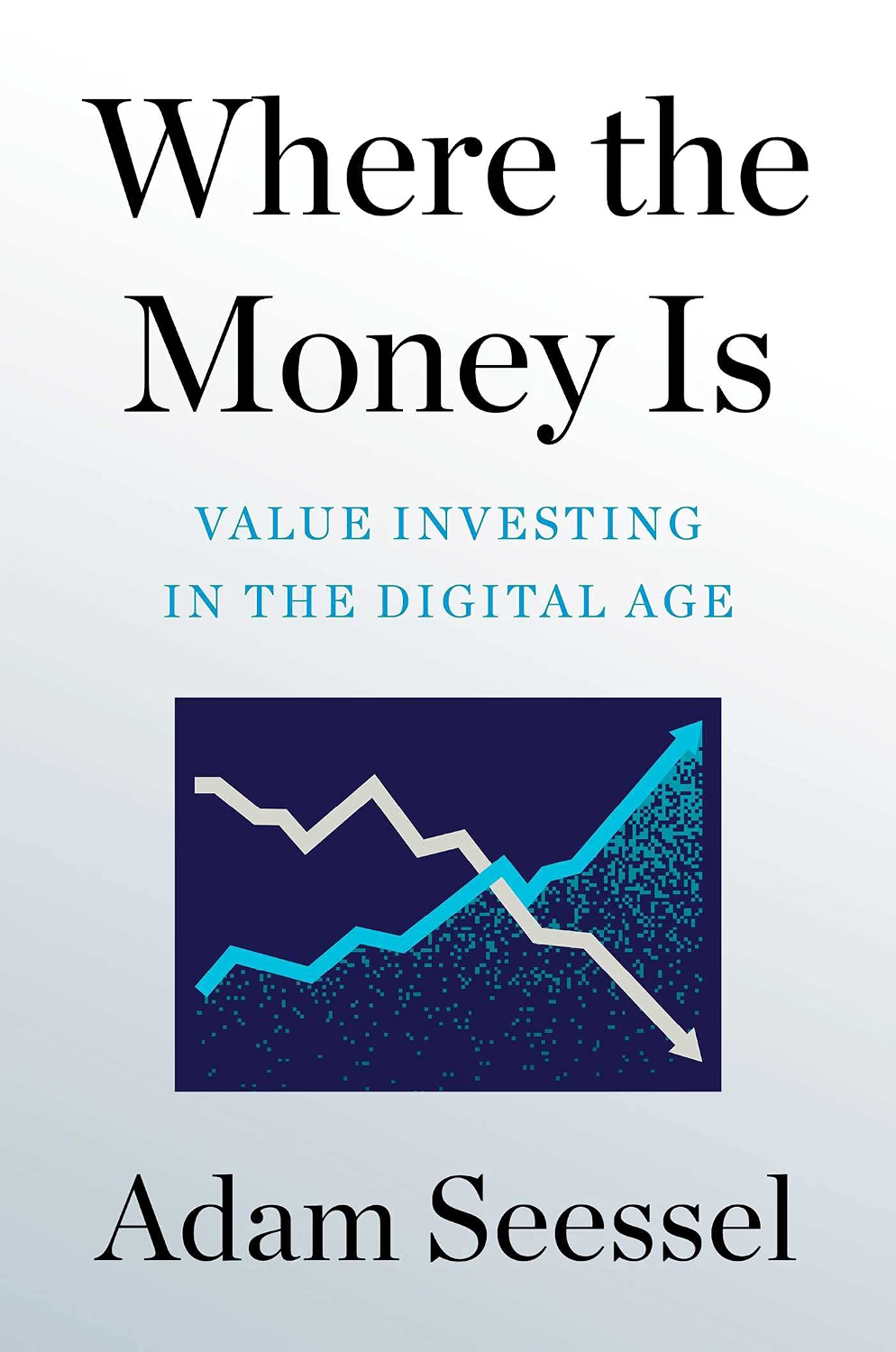
That question is central to Where the Money Is: Value Investing in the Digital Age by Adam Seessel. Published by Avid Reader Press, an imprint of Simon & Schuster, in 2022, the book is 272 pages and focuses on stocks, investment analysis, and the evolution of value investing.
Rather than treating technology companies as an entirely separate category of investment, Seessel’s approach examines how traditional concepts such as competitive advantage, management quality, valuation, and earnings power can be adapted to businesses operating in a digital economy.
The book traces an evolution from what it describes as “Value 1.0,” associated with Benjamin Graham’s asset-focused approach, through “Value 2.0,” associated with Warren Buffett’s emphasis on business quality and competitive advantages, toward the author’s proposed “Value 3.0.” The book’s table of contents shows that this framework is developed through discussions of competitive advantage, management, price, earnings power, case studies involving Alphabet and Intuit, and applications beyond technology companies.
For readers interested in investing, the subject is broader than simply identifying technology stocks. It raises fundamental questions about what makes a business valuable, how investors should think about growth, how competitive advantages evolve, and how financial analysis can adapt when economic value increasingly comes from intangible assets.
This article explores the ideas and educational themes surrounding the book, how it can be used as a learning resource, who may find it relevant, and what readers should keep in mind when applying investment concepts to real-world decisions.
Understanding Value Investing
Value investing is often associated with the idea of buying securities for less than their underlying value.
That simple description can hide a considerable amount of complexity.
Investors must determine what a business is worth, assess the quality and durability of its operations, examine its financial position, and consider whether the market price provides an adequate margin between price and estimated value.
Benjamin Graham’s work placed substantial emphasis on financial statements, assets, earnings, and purchasing securities at prices that provided a margin of safety.
Over time, the concept of value investing evolved.
Warren Buffett, for example, became associated with a greater emphasis on the quality of businesses, durable competitive advantages, management, and the ability of a company to generate attractive returns over long periods.
Seessel’s book argues that another evolution is necessary because the structure of many modern businesses differs significantly from that of traditional industrial companies. The publisher describes the book as an attempt to update value investing for a stock market increasingly influenced by technology-driven businesses.
Why the Digital Economy Creates a Different Investment Problem
A traditional industrial company might own factories, equipment, warehouses, vehicles, inventory, and other physical assets.
A modern software company may have a very different balance sheet.
Its most important resources might include:
- Software
- Algorithms
- Brand recognition
- Customer relationships
- Data
- Intellectual property
- Network effects
- Subscription relationships
- Distribution systems
- Developer ecosystems
Some of these assets can be difficult to evaluate using traditional measures.
This does not mean traditional financial analysis becomes irrelevant. Instead, it means investors may need to look beyond simple asset values.
A company can have relatively modest physical assets while generating substantial recurring revenue and cash flow.
The challenge for the investor is determining whether those earnings are durable.
Key Themes in Where the Money Is
The book is organized into three broad sections.
The first focuses on preparing to invest and traces the development of value investing.
The second examines tools for identifying potentially attractive businesses.
The third brings those concepts together into a broader investment process.
The published table of contents includes chapters covering the evolution of value investing, competitive advantage, management, price, earnings power, case studies involving Alphabet and Intuit, non-technology businesses, investment process, and regulation and innovation.
This structure makes the book more than a discussion of technology stocks. It is also an examination of how an investor might construct a framework for evaluating businesses.
Value 1.0: Benjamin Graham and Asset Values
One of the book’s early themes is the historical foundation of value investing.
Benjamin Graham developed an approach centered heavily on financial analysis and purchasing securities at prices that offered a significant margin of safety.
Graham’s environment was different from today’s technology-heavy market.
Companies often depended heavily on physical assets, and financial statements could provide a relatively direct picture of what a company owned.
For educational purposes, understanding this historical context is useful because it explains why certain traditional valuation methods developed in the first place.
An investor examining a manufacturing company with factories, inventory, equipment, and significant tangible assets may naturally place considerable emphasis on those assets.
The same approach may be less informative when examining a software platform whose most important competitive resources are intangible.
Value 2.0: The Buffett Influence
The book then examines what it calls “Value 2.0,” associated with Warren Buffett and the growing importance of business quality, brands, and durable competitive advantages.
The publisher describes Seessel’s framework as building on the intellectual traditions associated with Graham and Buffett while adapting them to the digital economy.
This evolution is important because it changes the central question.
Instead of asking only:
What assets does this company own?
the investor may also ask:
What allows this company to earn attractive returns over a long period?
That can lead to questions about customer loyalty, switching costs, pricing power, distribution, brand strength, network effects, scale, and other competitive characteristics.
Value 3.0 and the Digital Economy
The book’s proposed “Value 3.0” framework is intended to address the characteristics of modern digital businesses.
Its table of contents identifies “Value 3.0 and the BMP Checklist” as a central chapter, followed by chapters on competitive advantage, management, price, earnings power, and company case studies.
The idea is not simply that technology companies deserve higher valuations.
Instead, the framework asks investors to examine the underlying economics of the business.
A digital company may grow quickly, require comparatively little physical capital, and generate strong cash flows once it reaches scale.
But growth by itself does not guarantee that an investment will succeed.
An investor still needs to consider how much is being paid for that growth and whether competitors can eventually weaken the company’s position.
Competitive Advantage
Competitive advantage is one of the central concepts in business analysis.
A competitive advantage exists when a company possesses characteristics that make it difficult for competitors to take customers, reduce margins, or replicate the company’s economic position.
Potential sources can include:
- Strong brands
- Network effects
- Switching costs
- Cost advantages
- Scale
- Proprietary technology
- Distribution advantages
- Customer relationships
- Regulatory barriers
- Ecosystem effects
Not every company with one of these characteristics has a durable advantage.
The important question is durability.
A technology company can have a leading product today and face significant competition tomorrow.
Software can sometimes be copied or replaced.
Customer preferences can change.
New technologies can make existing products less relevant.
Regulation can alter the economics of an industry.
Consequently, competitive advantage should be treated as a dynamic concept rather than a permanent label.
Network Effects in Digital Businesses
Network effects are particularly relevant to many digital businesses.
A network effect occurs when a product or service becomes more useful as more people participate.
Social platforms are a familiar example.
A communication platform with very few users may have limited value. As more users join, the service can become more useful because participants have more people with whom they can interact.
Network effects can create powerful competitive dynamics.
However, investors should distinguish between genuine network effects and ordinary popularity.
A large user base does not automatically guarantee a durable competitive advantage.
The strength of the network, user engagement, switching costs, monetization ability, and presence of competing networks all matter.
Switching Costs
Switching costs are another potentially important source of competitive advantage.
A customer may remain with a particular software provider because moving to another system would require:
- Training employees
- Migrating data
- Changing workflows
- Rebuilding integrations
- Reconfiguring systems
- Learning new software
- Risking operational disruption
These costs can make customer relationships more durable.
However, switching costs can also decline over time.
New software tools may make migration easier. Competitors may offer incentives to switch. Standards may become more interoperable.
Therefore, investors should investigate whether switching costs are genuinely durable rather than assuming they will remain unchanged.
The Role of Management
The book dedicates a chapter to management, reflecting the idea that leadership remains important even as technology changes.
A company’s strategy can influence how effectively it converts resources into long-term economic value.
Management decisions can affect:
- Capital allocation
- Product development
- Hiring
- Acquisitions
- Research and development
- Share repurchases
- Debt levels
- Pricing
- Expansion
- Corporate governance
Good technology alone does not guarantee a good investment.
A company can operate in an attractive industry and still make poor strategic decisions.
Conversely, effective management can sometimes strengthen an existing competitive position.
The important lesson is that investors need to analyze the business and the people making major decisions about its future.
Price Still Matters
One of the most important principles in value investing is that a good business can still be an unattractive investment if the price paid is too high relative to its value.
This distinction is particularly important when analyzing technology companies.
Rapid growth can make a company appear attractive, but expectations may already be reflected in the stock price.
Suppose an investor estimates that a company could grow substantially for many years.
The next question is not simply whether that growth is possible.
It is whether the market price already assumes an even more optimistic outcome.
This is why valuation remains central even when the business itself is impressive.
Earnings Power
The book includes a chapter specifically focused on “Earnings Power,” another concept that connects business quality with valuation.
Earnings power can be thought of as the ability of a business to generate sustainable economic earnings over time.
The challenge is that current earnings do not always represent the long-term potential of a business.
A young software company might invest heavily in sales and development today, reducing current profits while building a larger customer base.
A mature company might have stable earnings but limited growth opportunities.
Comparing the two using a single earnings multiple without understanding their different stages of development can produce misleading conclusions.
The investor therefore needs to understand what is happening underneath the reported numbers.
Growth and Value Are Not Necessarily Opposites
A common investing discussion contrasts “value” stocks with “growth” stocks.
But the distinction can become misleading if value is defined simply as low valuation multiples and growth as high growth rates.
A rapidly growing company can have significant intrinsic value.
The key issue is whether the price paid appropriately reflects the expected future economics.
Likewise, a company with a low price-to-earnings ratio may not necessarily be undervalued.
Its earnings may be declining.
Its industry may be deteriorating.
Its competitive position may be weakening.
The deeper concept is therefore not simply cheap versus expensive.
It is the relationship between price, business quality, cash generation, growth, risk, and durability.
Alphabet and Intuit as Case Studies
The book includes case studies of Alphabet and Intuit.
Case studies can be especially useful when learning investment analysis because they show how abstract principles can be applied to actual businesses.
Alphabet provides an example of a large digital business with significant technology, advertising, platform, and ecosystem characteristics.
Intuit provides another example of software-driven business economics.
The purpose of studying such companies is not necessarily to conclude that they should be purchased.
Instead, case studies can help readers practice asking questions.
What is the company’s competitive advantage?
How durable is it?
How does the company make money?
What are its growth opportunities?
What could disrupt its position?
How much capital does it require?
What does management do with the cash it generates?
What expectations are reflected in the market price?
These questions are useful across many industries.
Investing in Non-Tech Companies
An important feature of the book is that its framework is not restricted to technology companies.
The table of contents includes a chapter specifically titled “Investing in Non-Tech Companies.”
This makes sense because digital transformation affects companies across the economy.
A retailer can use software to improve inventory management.
A financial company can digitize customer services.
A manufacturer can automate production.
A healthcare company can use technology to improve administrative processes.
A logistics company can use data and software to optimize routes.
The relevant question is therefore not simply whether a company is classified as “tech.”
It is how technology affects the company’s economics.
Buying What You Know With a Twist
The book also includes a chapter titled “Buy What You Know—With a Twist.”
The underlying concept can be useful for investors who encounter companies through everyday life.
People naturally observe businesses as customers.
They may notice products gaining popularity, services becoming easier to use, or companies appearing in their daily routines.
That information can be a starting point for research.
But being familiar with a product is not enough to justify an investment decision.
A company can have a popular product while still facing high competition, weak profitability, excessive valuation, regulatory challenges, or other risks.
Consumer familiarity should therefore generate questions rather than conclusions.
Turning Everyday Observations Into Research
Suppose someone notices that a particular software service is becoming increasingly common among small businesses.
Instead of immediately deciding that the company is an attractive investment, the observation can lead to a research process.
Ask:
- How large is the potential market?
- How quickly is the company gaining customers?
- How much does each customer contribute economically?
- How expensive is customer acquisition?
- Are customers staying?
- What prevents competitors from copying the service?
- Is the business generating cash?
- How much reinvestment is required?
- What risks could change the growth trajectory?
- What valuation does the stock market currently assign to the company?
This transforms a personal observation into a structured research question.
The Importance of Process
Investing involves uncertainty.
A disciplined process can help reduce the influence of emotions and short-term market movements.
The book includes a section on “Thoughts on Process and Priorities,” highlighting the role of process in investment decision-making.
A process might include:
- Defining the investment thesis
- Understanding the business
- Studying financial statements
- Identifying competitive advantages
- Assessing management
- Estimating earnings power
- Evaluating valuation
- Identifying risks
- Considering alternative explanations
- Monitoring new information
The objective is not to eliminate uncertainty.
No investment framework can do that.
Instead, the objective is to make decisions based on a repeatable set of questions.
Why Patience Matters
Value investing generally involves a longer time horizon than short-term trading.
If an investor believes a business will generate increasing economic value over many years, the market price may still fluctuate substantially along the way.
Short-term movements can be caused by:
- Economic data
- Interest rates
- Earnings announcements
- Investor sentiment
- Regulatory news
- Competitive developments
- Political events
- Industry cycles
These events can matter, but they do not necessarily change the underlying economics of a business.
A long-term investor therefore needs to distinguish between temporary price movement and meaningful changes to the investment thesis.
The Risk of Investment Gamification
Publishers Weekly’s description of the book notes that Seessel emphasizes rational analysis and warns against the “gamification” of investing associated with some trading applications.
This is an important educational distinction.
Investing and entertainment have different objectives.
A stock purchase represents ownership in a business, while frequent trading can encourage attention toward short-term price movements.
Features such as notifications, rapid execution, rankings, and constant market updates can make investing feel like a continuous game.
A disciplined investment process instead focuses attention on the underlying company.
That does not mean short-term trading is inherently invalid. It means different strategies involve different objectives, risks, costs, and decision-making processes.
Regulation and Innovation
The final section of the book includes a chapter on regulation, innovation, and what it calls the “second half of the chessboard.”
Technology companies can grow quickly, but innovation also attracts regulatory attention.
Governments may examine:
- Competition
- Market concentration
- Consumer protection
- Privacy
- Data use
- Artificial intelligence
- Digital advertising
- Platform behavior
- Financial technology
Regulation can change business economics.
An investor evaluating a digital company therefore needs to consider not only technology and market growth but also the legal environment in which the company operates.
How the Book Can Be Used as a Learning Resource
For Beginners
A beginner can use the book to become familiar with the language of value investing.
Concepts such as competitive advantage, earnings power, valuation, management, and business quality provide a foundation for further study.
For Intermediate Investors
An investor who already understands financial statements can use the framework to reconsider how traditional valuation concepts apply to asset-light businesses.
For Technology-Focused Investors
Readers interested in software, digital platforms, and technology companies can use the case studies and framework to develop a more structured approach to business analysis.
For Students
The book can provide a bridge between finance theory and real-world business analysis.
For Business Professionals
People working in technology or management may find the discussion useful for understanding how investors evaluate the businesses they work with.
A Practical Reading Method
Instead of reading the book from beginning to end without taking notes, readers can organize their study around several recurring questions.
For every company discussed, write down:
Business model: How does the company make money?
Customers: Who pays for the product or service?
Competitive advantage: Why do customers choose this company?
Durability: What could weaken that advantage?
Growth: Where could additional revenue come from?
Earnings power: What could the business earn under reasonable conditions?
Management: How are leaders allocating resources?
Valuation: What expectations appear to be reflected in the market price?
Risk: What could cause the investment thesis to fail?
This framework can turn the reading process into an analytical exercise.
Important Things to Consider
The Book Was Published in 2022
Technology and financial markets continue to change.
A book published in 2022 can provide a framework and historical perspective, but readers should not assume that every company example, market condition, valuation, or technology trend remains unchanged.
Current financial information should be obtained from up-to-date sources when making contemporary investment decisions.
Investment Frameworks Are Not Guarantees
No framework can guarantee investment results.
A disciplined process can help organize analysis, but unexpected events can change a company’s economics.
Historical Performance Does Not Predict Future Returns
The author’s professional background and investment record are part of the book’s context, but readers should not interpret past performance as a promise of future results. The publisher’s biography notes Seessel’s investment career and his work at firms including Sanford C. Bernstein, Baron Capital, and Davis Selected Advisers before founding Gravity Capital Management.
Historical performance should always be considered separately from the question of whether a particular investment is appropriate today.
Valuation Requires Assumptions
Estimating intrinsic value involves assumptions about future revenue, margins, growth, capital requirements, and risk.
Small changes in those assumptions can produce very different valuations.
This is particularly important for rapidly growing businesses because a large portion of estimated value may depend on future performance.
Technology Can Change Quickly
Competitive advantages in technology can be durable, but they can also disappear faster than investors expect.
New platforms, standards, business models, and technologies can change an industry’s economics.
A company’s competitive position therefore needs ongoing evaluation.
Comparing General Investment Book Categories
Traditional Value Investing Books
Classic value-investing books often emphasize financial statements, asset values, earnings, margins of safety, and disciplined valuation.
They provide important historical foundations.
Their limitation for some modern readers is that the examples may come from business environments very different from today’s digital economy.
Growth Investing Books
Growth-focused books emphasize expanding markets, revenue growth, competitive positioning, and companies capable of increasing earnings rapidly.
They can help investors understand expansion dynamics.
However, growth analysis still needs valuation discipline because rapid growth can be reflected in a company’s stock price.
Quantitative Investing Books
Quantitative resources focus more heavily on data, statistical relationships, factor investing, screening, and systematic portfolio construction.
They provide a different perspective from fundamental business analysis.
Behavioral Finance Books
Behavioral finance focuses on how psychological biases influence investment decisions.
This can complement business analysis because even a well-researched investment can be affected by emotional decision-making.
Digital-Economy Investment Books
Resources focused specifically on technology businesses examine issues such as software economics, network effects, platforms, recurring revenue, data, and intangible assets.
Where the Money Is fits partly into this category while retaining a value-investing framework.
Building a Research Checklist From the Book’s Themes
A useful checklist can combine the major ideas into one process.
Business
- What does the company sell?
- Who are its customers?
- How does it generate revenue?
- What are its major costs?
Competitive Advantage
- Why does the company have customers?
- What prevents competitors from taking them?
- Are switching costs significant?
- Are network effects present?
- Is the advantage becoming stronger or weaker?
Management
- How does management allocate capital?
- Does management communicate clearly?
- Are incentives aligned with long-term shareholders?
- How does leadership respond to changing market conditions?
Financials
- Is revenue growing?
- Are margins improving?
- What is the cash-flow profile?
- How much capital is required to grow?
- What is the company’s balance-sheet position?
Valuation
- What assumptions are reflected in the current price?
- What would need to happen for the valuation to make sense?
- What happens if growth is slower than expected?
- How sensitive is the valuation to different assumptions?
Risks
- What could disrupt the business?
- Who are the strongest competitors?
- Could regulation change the economics?
- Could technological change make the product less relevant?
This checklist can be applied to both technology and non-technology businesses.
Frequently Asked Questions
What is Where the Money Is: Value Investing in the Digital Age about?
The book by Adam Seessel examines how value-investing principles can be adapted to businesses operating in an increasingly digital economy. It discusses the evolution of value investing, competitive advantage, management, valuation, earnings power, technology companies, and investment process.
Who wrote the book?
The author is Adam Seessel, founder of Gravity Capital Management and a former investment professional at firms including Sanford C. Bernstein, Baron Capital, and Davis Selected Advisers. He has also contributed to publications including Barron’s and Fortune.
When was the book published?
The hardcover edition was published by Avid Reader Press/Simon & Schuster on May 24, 2022. The book is listed at 272 pages, with ISBN 9781982185145 and ISBN-10 1982185147.
What does “Value 3.0” mean?
Value 3.0 is the framework Seessel proposes for adapting value-investing principles to the characteristics of modern digital businesses.
The book develops the concept alongside discussions of competitive advantage, management, price, earnings power, and technology-company case studies.
Does the book focus only on technology stocks?
No.
Although digital businesses are central to the book’s argument, its contents also include a chapter specifically addressing investing in non-technology companies.
What companies are used as case studies?
The book includes case studies involving Alphabet and Intuit.
These examples are used to illustrate aspects of the author’s investment framework rather than functioning as simple lists of stocks to purchase.
Is the book about day trading?
The book’s framework is centered on fundamental business analysis and value investing rather than short-term trading.
Publishers Weekly notes that Seessel emphasizes rational analysis and cautions against the gamification of investing.
Does the book provide stock picks?
The emphasis is on an analytical framework rather than a simple list of investments.
Readers can use the concepts to analyze businesses, but individual investment decisions require current information and consideration of personal circumstances.
What is competitive advantage?
Competitive advantage refers to characteristics that can help a company maintain its position and generate attractive economics relative to competitors.
Examples can include brand strength, network effects, switching costs, scale, technology, or distribution.
The important issue is whether the advantage is durable.
What is earnings power?
Earnings power refers broadly to a company’s ability to generate sustainable economic earnings.
Analyzing earnings power requires understanding the business model, growth prospects, margins, capital requirements, and competitive position rather than looking at one year’s earnings in isolation.
Is this book suitable for beginners?
It can be useful for readers who want an introduction to the evolution of value investing and the challenges involved in analyzing modern businesses.
However, beginners may benefit from learning basic accounting and financial terminology alongside the book.
Can the ideas be applied to non-tech companies?
Yes.
The book explicitly includes material on investing in non-tech companies, suggesting that its framework is intended to extend beyond technology classifications.
Does the book guarantee investment success?
No investment book can guarantee investment returns.
The book presents a framework for analyzing businesses and investments, but actual outcomes depend on market conditions, company performance, valuation, risk, and many unpredictable factors.
Should readers use the book’s older company examples to make current investment decisions?
Not by themselves.
The book was published in 2022, and financial statements, valuations, competitive positions, technologies, and regulatory conditions can change.
Current information should be independently researched before making contemporary investment decisions.
Conclusion
Where the Money Is: Value Investing in the Digital Age by Adam Seessel examines an important question for modern investors: how should the principles of value investing adapt when economic value increasingly comes from software, digital platforms, brands, networks, data, and other intangible assets?
Published in 2022 by Avid Reader Press/Simon & Schuster, the 272-page book presents an evolution from the asset-oriented tradition associated with Benjamin Graham, through the business-quality approach associated with Warren Buffett, toward Seessel’s proposed “Value 3.0” framework.
The book’s structure emphasizes several recurring investment questions: What is a company’s competitive advantage? How durable is it? How capable is management? What is the company’s earnings power? What price is the market asking? What risks could undermine the investment thesis?
Those questions remain useful because they focus attention on the economics of a business rather than simply on its industry label.
The digital economy does create unusual analytical challenges. Some modern businesses can grow rapidly without requiring the same level of physical assets as traditional industrial companies. At the same time, technology can create powerful competitive advantages while also making existing advantages vulnerable to disruption.
For that reason, understanding a technology company’s business model is only the beginning. Investors also need to consider competition, customer behavior, capital requirements, management decisions, valuation, regulation, and the assumptions embedded in the market price.
One of the most practical ways to use the book is as a framework-building exercise. Rather than treating its concepts as instructions for specific investments, readers can use them to develop a repeatable process for researching companies and testing investment assumptions.
Value investing ultimately depends on judgment under uncertainty. A book can provide concepts, questions, and analytical frameworks, but it cannot remove the uncertainty inherent in financial markets.
For readers interested in how traditional value investing intersects with technology-driven business models, Where the Money Is provides a focused exploration of that transition and a framework for thinking about business quality, competitive advantage, earnings power, and valuation in a changing economy.
Leave a Reply