Technology has become inseparable from modern business. Whether a company is building a mobile application, launching an online marketplace, adopting cloud software, using artificial intelligence, or simply automating internal processes, technology is often at the center of important business decisions.
Yet many people responsible for those decisions are not software engineers.
Product managers, project managers, founders, entrepreneurs, operations professionals, marketing leaders, and business owners frequently need to work with developers, designers, data specialists, cybersecurity professionals, cloud engineers, and technology vendors. They may not need to write code themselves, but they do need to understand what the technical team is talking about.
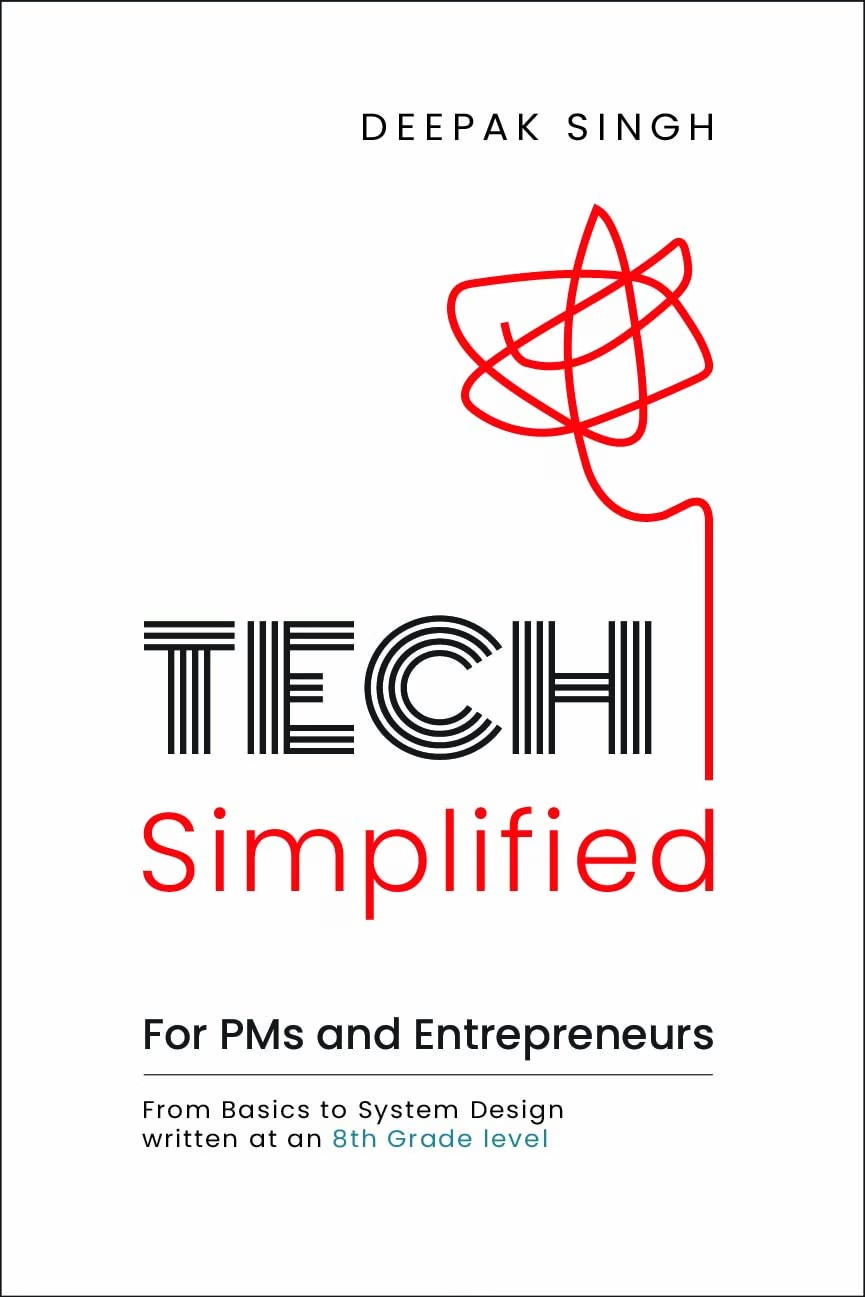
That is the practical space occupied by Tech Simplified for PMs and Entrepreneurs by Deepak Singh.
A technology-focused resource aimed at project managers and entrepreneurs can help bridge an important communication gap. Business professionals often understand the problem they want to solve, while technical professionals understand how software and infrastructure can be used to solve it. Effective technology projects require both sides to understand each other.
The goal is not for every entrepreneur or project manager to become a programmer. Instead, technology literacy can help business professionals ask better questions, recognize technical dependencies, understand project constraints, communicate requirements, and make more informed decisions.
This article explores the broader concepts that make technology easier to understand from a project-management and entrepreneurial perspective, along with practical ways a resource such as Tech Simplified for PMs and Entrepreneurs can fit into professional learning.
Why Technology Knowledge Matters for Project Managers and Entrepreneurs
A modern business project can involve dozens of technical decisions.
A seemingly straightforward idea such as “build an online store” may require decisions about:
- Website or application architecture
- Hosting
- Databases
- Payment processing
- User authentication
- Security
- APIs
- Analytics
- Search
- Mobile compatibility
- Backups
- Performance
- Scalability
- Data protection
An entrepreneur does not necessarily need to implement these components personally.
However, understanding their purpose can make it easier to evaluate proposals and communicate with technical teams.
The same applies to project managers.
A project manager may be responsible for timelines, budgets, communication, risks, and coordination. If the project involves software, technical dependencies can directly affect all of those areas.
For example, a delay in an external API integration could affect development and testing. A change in database architecture could affect the schedule. A security requirement discovered late in a project could require additional development work.
Basic technology knowledge can help a project manager recognize why these events matter.
What Does “Tech Simplified” Mean?
Technology can appear complicated because professionals use specialized terminology to describe systems that may have many interconnected parts.
Consider an ordinary mobile application.
From the user’s perspective, the application may simply display a login screen and a dashboard.
Behind that interface, however, the application could involve:
- Front-end code
- Back-end services
- APIs
- Databases
- Authentication
- Cloud infrastructure
- Monitoring
- Security controls
- Third-party services
A simplified explanation does not remove the underlying complexity.
Instead, it provides a conceptual map.
Once a project manager understands what each component does, conversations that previously sounded technical can become easier to follow.
Key Technology Concepts for PMs and Entrepreneurs
Hardware and Software
One of the first distinctions to understand is the difference between hardware and software.
Hardware refers to physical equipment such as:
- Computers
- Smartphones
- Servers
- Network devices
- Storage systems
- Sensors
Software consists of instructions and programs that run on hardware.
Business professionals interact with both, even when they do not think about them separately.
A startup might use laptops, cloud servers, mobile devices, and networking equipment while relying on accounting software, customer-management platforms, collaboration applications, and custom software.
Understanding this distinction provides a foundation for more advanced concepts.
Applications
An application is software designed to perform specific tasks.
Examples include:
- Mobile applications
- Web applications
- Desktop software
- Business systems
- Customer portals
- Internal tools
Applications may be built specifically for an organization or purchased from an existing vendor.
That distinction can affect cost, implementation time, customization, maintenance, and long-term flexibility.
Custom Software vs. Existing Software
An entrepreneur may face a choice between developing a custom solution and adopting an existing product.
Custom development can provide greater control over functionality, but it can also require more development resources and ongoing maintenance.
An existing platform may provide functionality quickly but may impose limitations on customization or integration.
There is no universal answer.
The appropriate choice depends on the organization’s requirements, budget, resources, timeline, and long-term strategy.
Front End and Back End
The terms “front end” and “back end” are frequently used in software projects.
The front end generally refers to the user-facing portion of an application.
It includes things such as:
- Screens
- Forms
- Buttons
- Menus
- Navigation
- Visual interactions
The back end generally refers to the server-side components that support the application.
These can include:
- Business logic
- Databases
- APIs
- Authentication systems
- Server processes
Understanding this distinction can help project managers break large development tasks into more understandable areas.
APIs
API stands for Application Programming Interface.
An API allows different software systems to communicate through defined interfaces.
For example, an e-commerce application might use an API to communicate with a payment service.
A travel application might use APIs to retrieve maps or external data.
A business management platform might use APIs to synchronize information with an accounting system.
For entrepreneurs, APIs are particularly important because modern businesses rarely operate in complete isolation.
Different tools often need to communicate with one another.
Databases
A database stores and organizes information so that applications can retrieve and manipulate it.
A company might have databases containing:
- Customer accounts
- Orders
- Inventory
- Employee records
- Product information
- Transactions
- Website activity
A project manager does not need to become a database administrator to understand why databases matter.
What matters is recognizing that many application features depend on structured information stored somewhere.
A request such as “add customer history to the dashboard” may involve changes to the application’s interface, business logic, database queries, and possibly data structures.
Cloud Computing
Cloud computing has changed how businesses acquire and operate technology.
Instead of maintaining all computing resources internally, organizations can use services provided through remote infrastructure.
Cloud services can provide:
- Computing
- Storage
- Databases
- Networking
- Security tools
- Development platforms
- Business applications
For entrepreneurs, cloud computing can provide access to technology infrastructure without requiring the organization to own and operate every physical server.
However, cloud services also introduce considerations involving cost management, security, vendor dependence, availability, data location, and access control.
Software as a Service
Software as a Service, or SaaS, is a model in which software is delivered as an ongoing service.
Businesses commonly use SaaS products for:
- Accounting
- CRM
- Marketing
- Project management
- Human resources
- Communication
- File storage
- Analytics
For a project manager, SaaS products can reduce the amount of infrastructure that needs to be developed internally.
At the same time, the project may depend on the vendor’s availability, APIs, pricing structure, data-export capabilities, and technical roadmap.
Cybersecurity Basics
Cybersecurity should not be treated as a purely technical subject.
A security problem can become a business problem very quickly.
A security incident could affect:
- Customer information
- Business operations
- Revenue
- Reputation
- Regulatory obligations
- Business continuity
PMs and entrepreneurs do not need to become cybersecurity engineers, but they should understand basic concepts.
Authentication
Authentication verifies identity.
A username and password are common examples.
Multi-factor authentication adds another layer, requiring additional evidence beyond a password.
Authorization
Authorization determines what an authenticated user is permitted to access or do.
These concepts are related but different.
Someone can successfully log in but still lack permission to access particular information.
Encryption
Encryption is used to protect information by transforming it into a form intended to prevent unauthorized parties from understanding it.
It can be applied to data in storage and data in transit, depending on the system.
Backups
Backups create additional copies of important information so that it can potentially be recovered after data loss or system failure.
A backup strategy should consider how frequently backups occur, where they are stored, how long they are retained, and whether restoration has actually been tested.
Software Development Life Cycle
Understanding how software projects progress can help PMs and entrepreneurs set realistic expectations.
A simplified development process may include:
- Requirements
- Planning
- Design
- Development
- Testing
- Deployment
- Monitoring
- Maintenance
Real projects do not always move through these stages in a perfectly linear sequence.
Modern development teams may work iteratively, continuously revisiting requirements and improvements.
The important point is that software development involves much more than writing code.
Requirements
Requirements describe what a product or system needs to accomplish.
A vague requirement might say:
“Users should have a better dashboard.”
A more useful requirement could explain:
“Users should be able to view their five most recent transactions, filter them by date, and export the results.”
Clear requirements reduce ambiguity.
They also make testing easier because the team has something specific against which the functionality can be evaluated.
Agile and Iterative Development
Many software teams use agile approaches to organize development.
Instead of attempting to define every detail years in advance, teams may work in shorter cycles and use feedback to refine the product.
Common concepts include:
- Backlogs
- User stories
- Sprints
- Iterations
- Reviews
- Retrospectives
For project managers, understanding these terms can make collaboration with development teams easier.
Agile does not mean that planning is unnecessary.
It generally means that planning and delivery can happen continuously as the project develops.
MVP and Product Development
Entrepreneurs often hear the term MVP, or Minimum Viable Product.
An MVP is generally a version of a product containing enough functionality to test important assumptions with users.
The idea is not simply to build the smallest possible product.
Instead, the objective is to learn whether the core proposition works before investing heavily in additional functionality.
For example, a startup may have twenty potential features.
Building all twenty before receiving user feedback could require significant time and resources.
An MVP approach might identify the central problem and develop a smaller set of capabilities needed to test the concept.
Technical Debt
Technical debt describes future costs created by technical shortcuts, compromises, or decisions that make later development more difficult.
For example, a startup might choose a quick implementation to meet an important deadline.
That may be a reasonable decision.
However, if the implementation later becomes difficult to maintain, the organization may need to spend additional time replacing or improving it.
Project managers should therefore understand that a fast technical solution is not automatically a low-cost solution in the long term.
Scalability
Scalability refers broadly to the ability of a system to handle increasing demands.
A startup might have 100 users today and 100,000 users several years later.
The technology that works for 100 users may not necessarily work efficiently at a much larger scale.
Scaling can involve:
- Computing resources
- Databases
- Networking
- Storage
- Application architecture
- Caching
- Infrastructure
Entrepreneurs should avoid assuming that every startup needs to build for enormous scale immediately.
Overengineering can also create unnecessary complexity.
The appropriate level of scalability depends on realistic business requirements and expected growth.
Technical Feasibility
A business idea may appear simple from a customer perspective but involve substantial technical challenges.
Suppose an entrepreneur proposes an application that needs real-time data from several external providers.
The technical team may identify challenges involving APIs, licensing, reliability, synchronization, or data quality.
A feasibility assessment can help determine:
- Whether the idea is technically possible
- What resources are required
- What external dependencies exist
- What risks need to be addressed
- How long implementation might take
Understanding the concept of technical feasibility can help entrepreneurs avoid treating every idea as equally straightforward to build.
Product Managers and Technology
Product managers frequently sit between business objectives, customer needs, design, and engineering.
This makes technical literacy particularly useful.
A product manager may need to answer questions such as:
- What problem are we solving?
- Which users are affected?
- What functionality is required?
- What technical dependencies exist?
- What can be delivered first?
- What risks could delay the project?
- How will success be measured?
The product manager does not necessarily make every technical decision.
Instead, the role often requires enough technical understanding to make informed product decisions alongside specialists.
Entrepreneurs and Technology Decisions
Entrepreneurs frequently have to make technology decisions before they have a large technical organization.
They may need to decide whether to:
- Hire developers
- Use a software agency
- Adopt SaaS tools
- Build internally
- Use low-code or no-code platforms
- Purchase existing software
- Integrate multiple services
- Use cloud infrastructure
Each option has tradeoffs.
A useful technology discussion should therefore go beyond asking what is technically possible.
It should also consider:
- Cost
- Time
- Risk
- Maintenance
- Security
- Flexibility
- Vendor dependence
- Future requirements
How Tech Simplified for PMs and Entrepreneurs Can Be Used
Preparing for Technical Meetings
A PM or entrepreneur can use foundational technology concepts before meetings with developers, engineers, or vendors.
Understanding terminology can make it easier to follow discussions and ask clarifying questions.
Evaluating Technical Proposals
Suppose a vendor recommends moving a system to a particular cloud architecture.
A non-technical decision-maker may not understand every implementation detail.
However, basic technical literacy allows them to ask:
- What problem does this architecture solve?
- What are the alternatives?
- What are the ongoing costs?
- How does it affect security?
- What happens if usage grows?
- What happens if we change providers?
Those questions can produce a much more useful discussion.
Managing Software Projects
Project managers can use technical knowledge to identify dependencies.
For example, a project might depend on:
- A third-party API
- Database migration
- Security testing
- App-store approval
- Cloud configuration
- User authentication
Recognizing those dependencies can improve project planning.
Communicating With Developers
Technical vocabulary can help PMs describe requirements more precisely.
At the same time, good communication requires avoiding unnecessary technical language when a business explanation is clearer.
A useful project manager should be able to move between business and technical perspectives.
Who May Find This Type of Resource Useful?
Project Managers
Project managers working with software or technology teams can benefit from understanding technical terminology and development processes.
Product Managers
Product managers regularly interact with engineers and designers and often need to balance customer needs with technical constraints.
Entrepreneurs
Founders may need to make technology decisions before hiring a large technical team.
Startup Teams
Early-stage companies often have people performing multiple roles.
A basic understanding of technology can help founders, operations staff, marketers, and other employees collaborate more effectively.
Business Analysts
Business analysts frequently translate business requirements into information that technical teams can use.
Technical literacy can support that translation process.
Consultants
Consultants working with technology-dependent businesses may need enough technical knowledge to understand systems and identify business implications.
Important Things to Consider
Technology Knowledge Does Not Replace Technical Expertise
Understanding what an API does is very different from designing a secure API architecture.
Knowing what a database is does not make someone a database administrator.
Technology literacy should therefore complement professional expertise rather than replace it.
Avoid Treating Technical Decisions as Universal
There is rarely one architecture that is correct for every organization.
The appropriate solution depends on requirements, resources, risk tolerance, users, regulations, existing systems, and future plans.
Technical Complexity Should Be Balanced Against Business Value
A technically sophisticated solution is not automatically more useful.
A startup may need a simple system that validates its business model.
A large enterprise may require extensive security, integration, monitoring, and scalability.
The right level of complexity depends on the problem.
Technology Changes Quickly
Cloud platforms, AI tools, programming frameworks, cybersecurity practices, and development methodologies continue to evolve.
A foundational resource can help establish concepts, but current technical documentation should be consulted when making implementation decisions.
Business Requirements Should Come First
Technology exists to support an objective.
Before choosing a tool or architecture, it is useful to identify the underlying business problem.
For example, instead of saying:
“We need AI.”
A business might ask:
“Which repetitive process are we trying to improve, and would an AI-based solution actually address it?”
That approach keeps technology connected to measurable business needs.
Comparing General Categories of Technology Resources
Technology Guides for Non-Technical Readers
These resources generally focus on concepts and vocabulary.
They can help professionals become comfortable with technology without requiring extensive technical training.
Programming Books
Programming books teach readers how to create software.
They generally involve significantly more technical detail and hands-on practice.
Technical Documentation
Technical documentation is designed to explain how specific products, platforms, frameworks, or services work.
It is essential for implementation but can be challenging for beginners.
Online Technology Courses
Courses can combine explanations, demonstrations, exercises, and projects.
They may be useful for learners who prefer structured instruction.
Business and Entrepreneurship Books
Business books often focus on strategy, finance, customers, operations, and growth.
Technology-focused resources complement these subjects by explaining the technical systems that support modern businesses.
From Technical Vocabulary to Better Decision-Making
Learning terminology is only the beginning.
The more valuable skill is knowing how to use technical knowledge when making decisions.
Imagine a company considering a new customer-management platform.
A decision-maker could ask:
What problem does the platform solve?
This keeps the discussion connected to business value.
How will it integrate with existing systems?
This identifies technical dependencies.
Who owns the data?
This raises data-management considerations.
How is access controlled?
This addresses security.
What happens if we leave the platform?
This considers data portability and vendor dependence.
What happens as our user base grows?
This addresses scalability.
These questions do not require programming expertise.
They require technology awareness.
Common Mistakes Non-Technical Leaders Can Avoid
Assuming Developers Understand the Business Automatically
Technical professionals may need detailed explanations of business priorities.
A requirement should communicate the intended outcome, not merely a technical solution.
Treating Estimates as Guarantees
Software development involves uncertainty.
Requirements can change, technical problems can emerge, and external dependencies can create delays.
A development estimate should therefore be understood in context rather than treated as an absolute promise.
Adding Features Without Considering Complexity
Every new feature can introduce development, testing, maintenance, security, and support requirements.
Feature decisions should consider both customer value and technical impact.
Ignoring Maintenance
Launching software is not necessarily the end of the project.
Applications may require:
- Security updates
- Bug fixes
- Infrastructure maintenance
- Monitoring
- New integrations
- Performance improvements
Long-term maintenance should be considered during planning.
Leaving Security Until the End
Security should be considered throughout development rather than treated only as a final checklist.
Requirements, architecture, access control, data handling, testing, and monitoring can all influence security.
Frequently Asked Questions
What is Tech Simplified for PMs and Entrepreneurs about?
The book is aimed at helping project managers and entrepreneurs understand technology concepts in a more accessible way. Its subject is particularly relevant to professionals who work with technical teams but may not have a traditional engineering or programming background.
Is the book only for project managers?
The title specifically identifies PMs and entrepreneurs, but the broader subject can also be relevant to product managers, business owners, startup teams, business analysts, consultants, and other professionals who regularly work with technology.
Do entrepreneurs need to know how to code?
Not necessarily.
Coding can be a valuable skill, but entrepreneurs can make effective technology decisions without becoming programmers.
Understanding fundamental concepts can help them communicate with technical specialists and evaluate technology choices.
What is the difference between a product manager and a project manager?
The exact responsibilities vary between organizations.
A product manager generally focuses on the product, its users, priorities, and business outcomes.
A project manager generally focuses more heavily on planning, coordination, schedules, resources, risks, and delivery.
There can be significant overlap, especially in smaller organizations.
Why should PMs understand APIs?
APIs are common dependencies in modern software projects.
A project manager who understands APIs can better recognize why an integration may require development, testing, documentation, authentication, and coordination with another provider.
What is cloud computing in simple terms?
Cloud computing involves using computing resources and services through remote infrastructure rather than relying entirely on locally managed hardware.
Cloud providers can offer services such as storage, databases, computing, networking, and software.
What is technical debt?
Technical debt describes future costs created by technical decisions that make later maintenance or development more difficult.
A short-term shortcut can sometimes be appropriate, but its long-term consequences should be understood.
What does scalability mean?
Scalability describes the ability of a system to handle changes in demand.
A scalable system can generally accommodate increasing workloads through appropriate technical approaches.
Why is cybersecurity relevant to entrepreneurs?
Entrepreneurs often manage customer information, business systems, payment processes, websites, and cloud services.
Security weaknesses can therefore affect both the organization and its customers.
What is an MVP?
An MVP, or Minimum Viable Product, is generally a version of a product designed to test important assumptions with a relatively focused set of capabilities.
The concept emphasizes learning and validation before extensive investment in additional features.
Do I need to understand databases to manage a software project?
You do not need to become a database specialist.
However, understanding what databases do and why applications depend on them can help you communicate more effectively with technical teams.
Can technical knowledge help with vendor selection?
Yes.
Understanding concepts such as integrations, APIs, security, data ownership, scalability, availability, and data portability can help business professionals ask more informed questions when evaluating technology vendors.
Does learning technology mean learning programming?
No.
Programming is one area of technology.
Technology literacy can also include understanding cloud computing, cybersecurity, databases, software development, networking, data, AI, and product architecture at a conceptual level.
How should a non-technical person start learning technology?
Start with foundational concepts and learn how they connect.
For example, understand applications, servers, databases, APIs, networks, cloud services, and security before moving into highly specialized technical subjects.
Conclusion
Tech Simplified for PMs and Entrepreneurs addresses a practical challenge facing many modern professionals: how to work effectively with technology without necessarily becoming a technical specialist.
For project managers and entrepreneurs, technology is rarely an isolated department.
It can influence product strategy, budgets, timelines, customer experience, operations, security, and growth. A decision to adopt a particular platform can affect the organization for years. A software project can depend on external APIs, databases, cloud infrastructure, security requirements, and third-party services.
Understanding the vocabulary behind these systems can make those decisions easier to discuss.
The most important benefit of technology literacy is not memorizing complicated terminology. It is developing the ability to ask better questions.
What does this system actually do?
Why is this technology required?
What are the alternatives?
What dependencies exist?
How will the system be secured?
What happens if the number of users increases?
Who owns the data?
What happens if the company changes vendors?
How much maintenance will the solution require?
Questions such as these can turn a confusing technical conversation into a productive business discussion.
At the same time, technology literacy should not be confused with technical expertise. Software engineers, architects, security professionals, database specialists, and other technical experts possess specialized knowledge that cannot be replaced by reading a general technology guide.
Instead, the goal is collaboration.
A project manager can understand enough technology to communicate requirements and recognize dependencies. An entrepreneur can understand enough to evaluate options and challenge assumptions. A product manager can understand enough to balance customer needs with technical constraints.
That shared understanding can help technical and business teams work toward the same objective.
As businesses continue adopting cloud services, software platforms, AI systems, automation, data tools, and connected applications, the ability to communicate across the technical and business divide is becoming an increasingly useful professional skill.
For readers looking to develop that foundation, Tech Simplified for PMs and Entrepreneurs provides a technology-focused starting point for exploring the concepts that increasingly shape modern projects and businesses.
Leave a Reply