Technology contracts sit behind many of the products and services used by modern organizations. A company purchasing cloud infrastructure, subscribing to business software, licensing intellectual property, hiring a technology vendor, outsourcing an IT function, or developing custom software may enter into several agreements before a project is complete.
These contracts can be difficult to understand because they combine ordinary commercial terms with technology-specific concepts. Questions about licensing, data, security, service levels, intellectual property, warranties, limitations of liability, support, termination, and confidentiality can all become important at the same time.
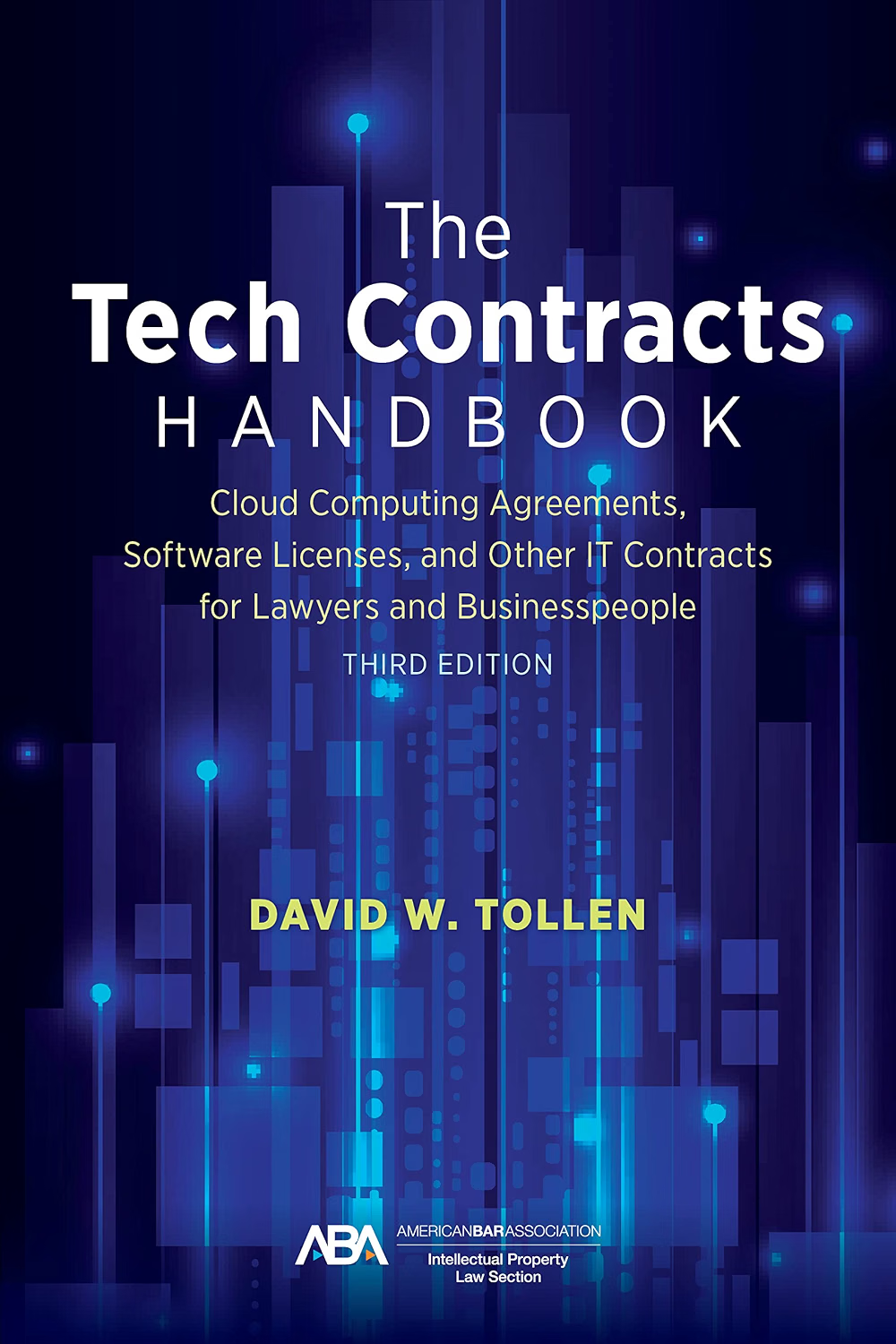
The Tech Contracts Handbook: Cloud Computing Agreements, Software Licenses, and Other IT Contracts for Lawyers and Businesspeople, Third Edition addresses this intersection between technology and contracting. The book is associated with technology transactions attorney David W. Tollen and is designed to help lawyers and business professionals understand and work with agreements commonly used in the technology sector.
The subject is particularly relevant as organizations increasingly depend on cloud platforms, software-as-a-service applications, hosted systems, APIs, outsourced technology services, and digitally delivered products.
A technology contract is rarely just about the price of a service. It can determine who owns intellectual property, who can use data, what happens when a service becomes unavailable, how security responsibilities are divided, what support is included, and what happens when the relationship ends.
This guide explores the themes and practical uses of The Tech Contracts Handbook, explains common technology-contract concepts, and shows how a structured understanding of IT agreements can help lawyers, businesspeople, procurement teams, technology professionals, and other stakeholders communicate more effectively.
Understanding Technology Contracts
A technology contract is an agreement governing the relationship between parties involved in a technology product, service, license, project, or transaction.
Examples include:
- Software licenses
- Cloud service agreements
- Software-as-a-service contracts
- Technology development agreements
- IT outsourcing contracts
- Consulting agreements
- Hosting agreements
- Support and maintenance contracts
- Data-processing arrangements
- Intellectual-property licenses
- Service-level agreements
- Technology procurement agreements
Each type of contract has its own characteristics.
A software license may focus heavily on intellectual-property rights and permitted use.
A cloud agreement may emphasize service availability, security, data handling, support, and termination.
A software development agreement may focus on deliverables, ownership of newly created intellectual property, acceptance testing, milestones, and change management.
The common thread is that the contract establishes rules for how technology will be delivered, used, supported, paid for, protected, and eventually terminated.
Why Technology Contracts Can Be Complex
Traditional commercial contracts already contain many legal concepts.
Technology agreements add another layer because the subject matter itself can be complicated.
A lawyer or businessperson may need to understand:
- Software architecture
- Cloud infrastructure
- Data storage
- APIs
- Security controls
- Intellectual property
- User accounts
- Service availability
- Technical support
- Data migration
- System integrations
- Software updates
A contract can therefore contain language that makes little sense without understanding the underlying technology.
For example, a clause about “availability” is easier to evaluate if the reader understands that a cloud service can experience outages, scheduled maintenance, degraded performance, or partial failures.
Likewise, a data-protection clause is easier to interpret when the parties understand where the data is stored, who processes it, what subcontractors are involved, and how access is controlled.
Key Themes of The Tech Contracts Handbook
The book’s subject matter covers a broad range of technology agreements and the practical issues that arise when negotiating them.
Its emphasis on cloud computing agreements, software licenses, and other IT contracts makes it relevant to organizations that purchase, sell, develop, license, or manage technology.
Several themes are particularly important.
Software Licensing
Software is generally not purchased in the same way as a physical product.
Instead, customers often receive defined rights to use software subject to contractual restrictions.
A license may specify:
- Who may use the software
- How many users are permitted
- Which devices may access it
- Where it may be deployed
- Whether it can be modified
- Whether it can be sublicensed
- How long the rights continue
- What happens after termination
Understanding the distinction between ownership and licensing is fundamental.
A customer may pay for access to software without acquiring ownership of the underlying intellectual property.
Cloud Computing Agreements
Cloud services introduce another set of contractual considerations.
Instead of installing software entirely on company-owned infrastructure, a customer may access computing resources or applications operated by a third-party provider.
Common cloud service models include:
- Infrastructure as a Service
- Platform as a Service
- Software as a Service
The contractual relationship may address availability, security, data handling, support, service credits, backups, subcontractors, and termination.
The customer may also need to understand what responsibilities remain with the customer and what responsibilities belong to the provider.
Software as a Service
Software-as-a-service arrangements are now common across business operations.
Companies may use cloud applications for:
- Accounting
- Customer relationship management
- Human resources
- Marketing
- Collaboration
- Project management
- File storage
- Analytics
- Communication
- Security
A SaaS agreement therefore becomes more than a simple software license.
The customer is purchasing an ongoing service.
That makes questions about service continuity particularly important.
Service-Level Agreements
A service-level agreement, often called an SLA, establishes measurable expectations for service performance.
Depending on the arrangement, an SLA may address:
- Availability
- Response times
- Resolution times
- Support hours
- Maintenance windows
- Incident management
- Service credits
An SLA is useful only when the underlying measurements are clearly defined.
For example, “99.9% uptime” sounds precise, but a contract should clarify how uptime is measured, what exclusions apply, how scheduled maintenance is treated, and what remedy is available if the commitment is missed.
Intellectual Property
Intellectual property is one of the most important issues in technology agreements.
Different types of intellectual property can be involved, including:
- Copyright
- Patents
- Trademarks
- Trade secrets
- Proprietary software
- Documentation
- Databases
- Designs
- Technical processes
A technology contract should make clear which party owns existing intellectual property and what rights are granted to the other party.
This distinction becomes particularly important in software development projects.
Background IP and Newly Created IP
Imagine a company hires a developer to create a custom software application.
The developer may already own frameworks, libraries, tools, templates, or reusable code.
The customer may expect to own everything delivered as part of the project.
Those expectations can conflict unless the agreement addresses them clearly.
A well-structured contract can distinguish between:
Background intellectual property: technology that existed before the project.
Project-specific intellectual property: material created specifically for the customer.
The contract can then define the rights associated with each category.
The exact legal treatment depends on the agreement, jurisdiction, and circumstances.
Data Ownership and Data Rights
Data has become one of the most important assets in modern businesses.
Technology contracts may involve customer information, employee information, transaction records, analytics, usage data, and other categories of information.
The contract should make clear how data is handled.
Important questions may include:
- Who owns the data?
- Who can access it?
- Can the provider use it for analytics?
- Can it be used to improve services?
- How long is it retained?
- Where is it stored?
- Can it be transferred to another provider?
- What happens after termination?
These questions become particularly important in cloud and SaaS arrangements.
Data Security
Technology contracts increasingly address cybersecurity responsibilities.
Security provisions may cover:
- Access controls
- Encryption
- Incident response
- Security testing
- Vulnerability management
- Employee access
- Subcontractors
- Audit rights
- Breach notification
The important point is that a contract should allocate responsibilities rather than simply stating that “security will be maintained.”
Different parties may control different parts of the technology environment.
A cloud provider might operate the infrastructure while the customer controls user accounts and permissions.
Understanding that division of responsibility can prevent misunderstandings.
Privacy and Data Protection
Privacy obligations can vary significantly depending on the type of information involved and the jurisdictions in which the parties operate.
Technology agreements may therefore need to address applicable privacy and data-protection requirements.
Depending on the relationship, a contract may include provisions covering:
- Personal information
- Data processing
- International transfers
- Subprocessors
- Security measures
- Data deletion
- Data access
- Regulatory cooperation
Because privacy laws change and vary by jurisdiction, contractual language should be evaluated against the applicable legal requirements rather than treated as universal.
Warranties
Warranties establish contractual statements about a product, service, or party’s performance.
Technology agreements may contain warranties concerning:
- Conformity to documentation
- Professional services
- Intellectual-property rights
- Security practices
- Compliance
- Functionality
The scope of warranties varies significantly.
A business should understand exactly what the provider promises and what limitations apply.
Disclaimers
Technology contracts may also contain disclaimers limiting warranties or responsibility for certain outcomes.
A service provider might not guarantee that software will operate without interruption or that every defect will be corrected immediately.
Understanding the relationship between warranties and disclaimers is important because the contract may contain several provisions that need to be read together.
Limitation of Liability
Limitation-of-liability clauses can be among the most consequential provisions in a technology contract.
A contract might establish a maximum amount that one party can recover from the other for certain claims.
It may also identify categories of damages that are excluded.
However, liability clauses frequently contain exceptions.
Potential exceptions can relate to matters such as:
- Confidentiality
- Intellectual-property infringement
- Data breaches
- Fraud
- Intentional misconduct
The actual language varies from contract to contract.
Because liability allocation can significantly affect financial risk, it is an area that often requires careful legal analysis.
Indemnification
Indemnification provisions determine when one party may be responsible for certain losses or claims involving the other party.
Technology agreements may contain intellectual-property indemnities, for example.
The scope of an indemnity can depend on definitions, exclusions, procedures, and limitations elsewhere in the agreement.
A businessperson reading an indemnity should therefore examine not only the headline promise but also the conditions under which it applies.
Confidentiality
Technology transactions frequently involve sensitive information.
A company evaluating a software vendor may disclose business processes.
A software developer may receive proprietary technical information.
A cloud provider may process sensitive customer information.
Confidentiality provisions can establish rules concerning how information is protected, who can access it, and what happens when the relationship ends.
Termination
A technology contract should address how the relationship can end.
Termination provisions may distinguish between:
- Termination for convenience
- Termination for material breach
- Termination for insolvency
- Termination following repeated service failures
- Expiration of a fixed term
The consequences of termination can be just as important as the termination right itself.
For example, what happens to customer data?
Can the customer export information?
Does the provider provide migration assistance?
How long will data remain available?
Does the customer continue paying during a transition period?
These questions are particularly important for cloud and SaaS contracts.
How the Handbook Can Be Used
A technology-contract handbook can be used in several ways.
As a Learning Resource
Law students, junior attorneys, business professionals, and technology managers can use it to become familiar with common contract structures and terminology.
During Contract Review
A reader can use the concepts in the book as a checklist when reviewing an agreement.
Instead of reading the contract only from beginning to end, the reviewer can identify major categories such as:
- Scope
- Fees
- Licensing
- Intellectual property
- Data
- Security
- Support
- Availability
- Liability
- Indemnification
- Termination
This structured approach can make long technology contracts easier to analyze.
During Negotiation
The handbook can also provide context for negotiations.
A businessperson may understand what the company wants commercially but not know which contractual provision addresses the concern.
For example:
“We need the ability to recover our data when the service ends.”
That concern may lead to questions about data export, termination assistance, retention periods, and migration support.
For Vendor Management
Procurement teams frequently work with technology suppliers.
Understanding common contractual provisions can help procurement professionals identify questions before sending an agreement to legal counsel.
For Technology Managers
Technology professionals may understand how a system works but have less familiarity with the legal implications of a contract.
A technology-contract reference can help bridge that communication gap.
A Practical Cloud Contract Checklist
When reviewing a cloud agreement, a business can ask several foundational questions.
Service
What exactly is being provided?
Which features are included?
What services are excluded?
Availability
What availability commitment exists?
How is it measured?
What exceptions apply?
Support
When is support available?
What response times apply?
Which severity levels exist?
Data
What data will the provider process?
Where is it stored?
Who can access it?
Security
What security measures are required?
How are incidents handled?
Are audits or certifications relevant?
Subcontractors
Can the provider use third parties?
What responsibility does the provider retain for those subcontractors?
Intellectual Property
Who owns the software?
Who owns customer data?
What rights does each party receive?
Termination
What happens when the agreement ends?
How is data returned or deleted?
Liability
What financial exposure does each party accept?
Are there caps or exclusions?
Changes
Can the provider change the service or contract?
How much notice is required?
These questions are starting points rather than substitutes for legal advice.
Software License Agreements
Software licenses can take many forms.
A license might cover software installed locally on company computers.
Another arrangement might provide access through a browser.
Some software can be licensed by user.
Other arrangements may use device, server, transaction, or usage-based metrics.
The license model matters because it determines what the customer is actually permitted to do.
Named Users
A named-user license may limit access to specific individuals.
Concurrent Users
A concurrent-user model may limit how many people can access the software simultaneously.
Device-Based Licensing
A license may be associated with a particular number of devices.
Enterprise Licensing
Large organizations may negotiate broader usage rights across departments or geographic locations.
Understanding the licensing metric is essential because accidental overdeployment can create contractual issues.
Open-Source Software
Technology contracts can also involve open-source components.
Open-source software is not necessarily “free of obligations.”
Different open-source licenses impose different requirements.
Depending on the license and how the software is used or distributed, obligations may involve notices, attribution, source-code availability, or licensing conditions.
Organizations using third-party software should understand what open-source components are incorporated into their technology products and what obligations may apply.
Software Development Agreements
Custom development projects introduce another set of contractual issues.
A development agreement may specify:
- Project scope
- Requirements
- Milestones
- Deliverables
- Testing
- Acceptance
- Fees
- Change requests
- Intellectual property
- Documentation
- Support
- Warranties
- Termination
Scope management is particularly important.
A project can become difficult when the customer expects functionality that was never included in the original requirements.
A well-defined change-control process can help distinguish original work from additional requests.
Acceptance Testing
Acceptance testing establishes how the customer determines whether a deliverable meets agreed requirements.
Without clear acceptance criteria, disputes can arise.
For example, a customer might believe that software is incomplete while the vendor considers the project finished.
A contract can address this by defining:
- Testing procedures
- Acceptance criteria
- Testing periods
- Defect categories
- Correction periods
- Re-testing procedures
The exact structure depends on the project.
Service and Support Agreements
Technology products often require ongoing support.
A support agreement can define:
- Support channels
- Support hours
- Response targets
- Resolution targets
- Escalation procedures
- Maintenance
- Updates
- Upgrades
These provisions are particularly important when a business depends on the technology for critical operations.
Who May Find the Handbook Useful?
Technology Lawyers
Attorneys working with software, cloud, licensing, or IT transactions can use a technology-contract reference to organize their understanding of recurring issues.
Business Lawyers
General commercial lawyers may encounter technology provisions even when technology contracts are not their primary specialization.
Procurement Professionals
Procurement teams frequently negotiate technology purchases and renewals.
Understanding contract terminology can help them identify commercial questions before legal review.
Business Owners
Small and medium-sized businesses increasingly rely on cloud services and software subscriptions.
Business owners may benefit from understanding the major contractual risks before signing technology agreements.
IT Managers
Technology leaders can use contract concepts to communicate more effectively with legal and procurement teams.
Technology Vendors
Companies selling software or IT services need to understand the contractual expectations of their customers.
Students and Professionals Learning Technology Law
The book can also provide a useful introduction to the relationship between technology operations and commercial contracts.
Important Things to Consider
The Handbook Is Not a Substitute for Legal Advice
Technology contracts can involve significant legal and financial consequences.
A handbook can explain concepts and common contract structures, but it cannot determine how a particular agreement should be drafted or interpreted in every jurisdiction.
For a material transaction, qualified legal counsel may be appropriate.
Laws Differ by Jurisdiction
Contract law, privacy law, intellectual-property law, consumer protection, and other legal requirements can differ by country, state, or other jurisdiction.
A general explanation should not be treated as universal legal advice.
Technology Changes Quickly
Cloud services, artificial intelligence, cybersecurity, data regulations, software licensing models, and other technology practices continue to evolve.
A third edition provides a particular point in time and should be supplemented with current legal and technical information when addressing contemporary transactions.
Contract Language Must Be Read as a Whole
A single clause rarely tells the entire story.
Definitions can change the meaning of operative provisions.
An indemnity may be affected by a liability cap.
A termination clause may be connected to data-return provisions.
A service-level commitment may depend on exclusions.
Reading clauses in isolation can therefore create an incomplete understanding.
Comparing General Categories of Technology Contract Resources
General Contract Law Books
General contract law resources provide foundational principles such as offer, acceptance, consideration, breach, remedies, and interpretation.
They are useful for understanding the broader legal framework.
However, they may not explain the technical details of SaaS, software licensing, cloud services, or IT outsourcing.
Technology Contract Handbooks
Technology-focused handbooks concentrate on the issues that arise specifically in IT transactions.
They can help bridge the gap between general contract law and technical business arrangements.
Vendor Templates
A vendor’s standard agreement provides the actual contractual terms for a particular service.
It is essential for a transaction but may naturally reflect the provider’s preferred structure.
A handbook can help readers understand the categories of provisions they encounter in such documents.
Practical Negotiation Guides
Negotiation-focused resources emphasize strategies and tactics.
They can complement a technology-contract handbook by focusing more heavily on the process of reaching an agreement.
Technical Documentation
Technical documentation explains how a technology works.
It is essential for understanding the service itself but generally does not replace contractual analysis.
For example, API documentation can explain how an interface operates, while a contract determines rights, responsibilities, support, warranties, and liability surrounding that service.
Building a Technology Contract Review Process
A business can create a repeatable process for reviewing IT agreements.
Step 1: Understand the Business Purpose
What is the company actually buying?
Step 2: Identify the Technology
What software, infrastructure, data, or service is involved?
Step 3: Map Responsibilities
Which party is responsible for each part of the system?
Step 4: Review Commercial Terms
Examine fees, billing, renewal, term, and usage limits.
Step 5: Review Operational Terms
Examine support, availability, maintenance, updates, and service levels.
Step 6: Review Legal Risk
Examine intellectual property, confidentiality, indemnification, warranties, and liability.
Step 7: Review Data
Determine how customer and personal information is handled.
Step 8: Review Exit Rights
Determine what happens when the agreement ends.
Step 9: Identify Open Questions
Create a list of issues requiring clarification or negotiation.
Step 10: Obtain Appropriate Legal Review
Material agreements may require review by qualified counsel.
Why Contract Definitions Matter
Definitions are easy to overlook.
A contract may define terms such as:
- Confidential Information
- Customer Data
- Services
- Documentation
- Intellectual Property
- Security Incident
- Authorized User
- Personal Data
Those definitions can affect the meaning of provisions throughout the agreement.
For example, if “Customer Data” is narrowly defined, some information that the customer expects to be protected may fall outside the contractual definition.
A careful reviewer therefore needs to understand not only the main clauses but also the definitions section.
Renewals and Automatic Extensions
Many software and cloud agreements renew automatically unless notice is provided within a particular period.
This can create practical problems if the customer misses the cancellation deadline.
A contract review process should therefore track:
- Renewal date
- Notice deadline
- Price changes
- Renewal terms
- Termination rights
This is particularly important for businesses managing many software subscriptions.
Data Portability and Vendor Lock-In
Cloud services can create significant switching costs.
A business may depend on a provider for years and accumulate large amounts of data, configurations, integrations, and workflows.
When evaluating a technology contract, it can therefore be useful to consider the exit process before the relationship begins.
Questions include:
- Can data be exported?
- In what format?
- Is there an export fee?
- How long is data available after termination?
- Does the vendor provide migration assistance?
- Are APIs available?
- What happens to backups?
Planning for exit does not imply that the relationship will fail.
It is simply a way of recognizing that technology transitions can be complicated.
Frequently Asked Questions
What is The Tech Contracts Handbook about?
The Tech Contracts Handbook focuses on technology agreements such as cloud computing contracts, software licenses, and other IT contracts. It is intended for lawyers and businesspeople who work with technology transactions.
Who is the handbook intended for?
The subject matter is relevant to technology lawyers, business attorneys, procurement professionals, business owners, IT managers, technology vendors, and others involved in negotiating or managing technology agreements.
What types of contracts does it discuss?
The subject includes cloud computing agreements, software licenses, and other IT-related contracts. Technology transactions can also involve development agreements, support arrangements, service-level agreements, outsourcing contracts, and intellectual-property provisions.
Why are cloud contracts different from traditional software licenses?
A traditional software license may primarily grant rights to use software.
A cloud agreement often governs an ongoing service, making availability, support, security, data handling, and termination particularly important.
What is an SLA?
SLA stands for Service Level Agreement.
It generally defines measurable service commitments, such as availability, support response, or incident handling.
What is a software license?
A software license grants specified rights to use software without necessarily transferring ownership of the underlying intellectual property.
The precise rights depend on the contract.
Who owns software created for a customer?
The answer depends on the contract, applicable law, and the distinction between pre-existing intellectual property and newly created work.
A development agreement should clearly address ownership and licensing rights.
What is a limitation of liability?
A limitation-of-liability provision generally establishes boundaries around the financial responsibility one party may have for certain claims or damages.
The exact effect depends on the contract language and applicable law.
What is indemnification?
Indemnification generally involves one party agreeing to protect or reimburse another party for specified losses or claims, subject to the terms and limitations of the agreement.
Why is data ownership important in cloud contracts?
A business may store valuable or sensitive information in a cloud service.
The contract should address how the data can be used, accessed, protected, exported, retained, and deleted.
What happens to data when a SaaS contract ends?
The answer should be addressed in the agreement.
Important issues can include data export, format, timing, migration assistance, retention periods, and deletion.
Is the handbook a replacement for a lawyer?
No.
A book can provide educational information and help readers understand common contract concepts, but legal advice should be obtained from appropriately qualified counsel when a specific transaction requires it.
Can a businessperson use the book without being a lawyer?
Yes.
Technology contracts affect business decisions as well as legal rights, so understanding common contractual concepts can be useful for non-lawyers involved in procurement, technology management, or vendor relationships.
Does the handbook cover only cloud computing?
No.
Cloud computing is an important subject, but the book also addresses software licenses and other IT contracts.
Why should IT managers understand contracts?
IT managers often understand the technical environment better than anyone else in the organization.
Understanding contractual responsibilities can help them communicate with legal, procurement, vendors, and business leadership about what the technology agreement actually requires.
What should a company look at before signing a technology contract?
At a minimum, the company should understand the scope of services, fees, term, renewal, intellectual property, data handling, security, support, service levels, warranties, liability, indemnification, termination, and data portability.
The appropriate level of legal review depends on the transaction.
Conclusion
The Tech Contracts Handbook: Cloud Computing Agreements, Software Licenses, and Other IT Contracts for Lawyers and Businesspeople, Third Edition addresses a subject that has become increasingly important as organizations rely on software, cloud infrastructure, digital platforms, and technology vendors.
Technology contracts are not simply legal documents describing a purchase. They define how technology is delivered, how software can be used, who owns intellectual property, how data is handled, what security responsibilities apply, what support a customer receives, and what happens when the relationship ends.
For cloud services in particular, the contractual relationship can continue for years. Questions about availability, security, data portability, subcontractors, service levels, renewals, and termination can become just as important as the initial commercial terms.
For software development projects, intellectual-property ownership, scope, milestones, acceptance testing, change management, and support can determine whether both parties have the same expectations.
For software licenses, the central questions may involve authorized users, permitted uses, deployment restrictions, intellectual-property rights, and licensing metrics.
A technology-contract handbook can help readers recognize these recurring issues and understand the vocabulary used to discuss them.
The book can be useful as an educational reference for lawyers and businesspeople, but its practical value also extends to procurement professionals, IT managers, technology vendors, students, and business owners who regularly encounter technology agreements.
At the same time, technology contracts should always be evaluated in their specific context. Laws differ between jurisdictions, technology changes quickly, and the meaning of one clause can depend on definitions and provisions elsewhere in the agreement.
The most useful approach is therefore to combine contractual knowledge with an understanding of the underlying technology and the business relationship.
Whether the agreement concerns cloud computing, SaaS, software licensing, IT services, custom development, or another technology transaction, the same basic questions remain important: What is being provided? What rights are being granted? Who is responsible for what? How is risk allocated? How is data protected? What happens if something goes wrong? And how can the relationship end without leaving the business unable to operate?
Those questions provide a practical foundation for understanding technology contracts in an increasingly digital business environment.
Leave a Reply